Winning a customer is only the beginning of the relationship.In 2026, businesses are realizing that sustainable digital growth does not come from constantly chasing new customers. It comes from understanding what people need before they buy, helping them make the right decision, keeping them engaged after the purchase, and creating enough value for them to return.
That is where lifecycle marketing comes in.Lifecycle marketing focuses on communicating with customers differently depending on where they are in their relationship with your business. Instead of sending the same message to everyone, brands build experiences around customer behaviour, interests, purchase history and intent.
For any digital marketing agency, this shift has become increasingly important because marketing success is no longer measured only by traffic or customer acquisition. Retention, repeat purchases, customer lifetime value and long-term engagement have become equally important indicators of growth.
What Is Lifecycle Marketing?
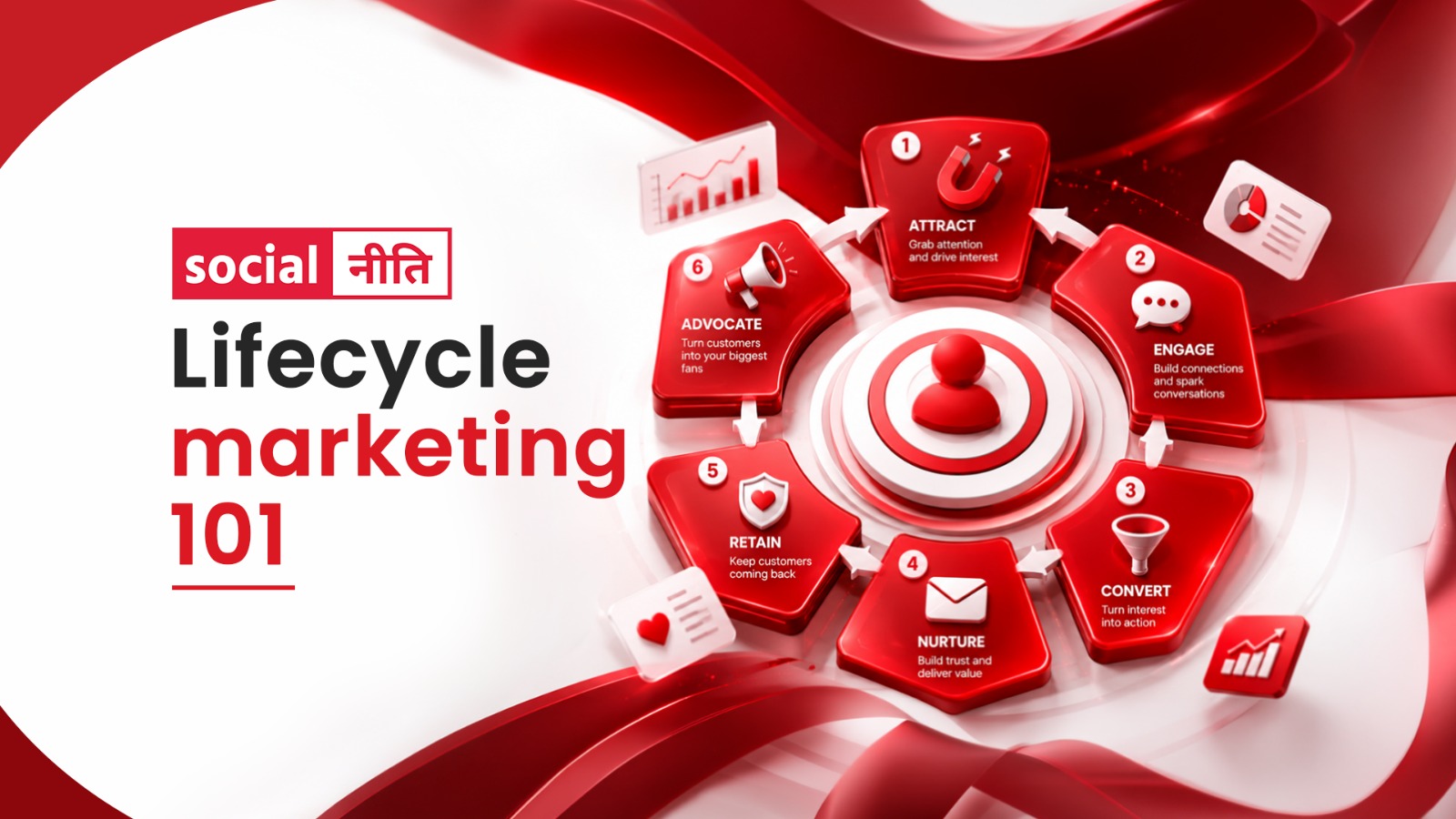
Lifecycle marketing is a strategy that engages customers across the complete journey they have with a business.
The journey can broadly be divided into:
- Awareness
- Consideration
- Conversion
- Onboarding
- Engagement
- Retention
- Loyalty and advocacy
- Re-engagement
Each stage requires a different communication strategy.A person discovering your business for the first time should not receive the same communication as someone who has already purchased multiple times.Effective lifecycle marketing uses customer data, behavioural signals, automation, segmentation and analytics to determine what communication should be delivered and when.This is becoming particularly important in 2026. A recent lifecycle marketing survey found that while 60% of marketing teams still prioritize acquisition, 45% now prioritize retention, showing that the historical gap between customer acquisition and retention is narrowing.
Stage 1: Awareness – Getting in Front of the Right Audience
The lifecycle begins before someone becomes a customer.
At the awareness stage, businesses need to introduce themselves to people who are likely to have a genuine interest in their products or services.
This can involve:
- Search visibility
- Social media content
- Performance campaigns
- Educational content
- Website experiences
- Audience targeting
- Video and visual communication
The objective is not simply generating impressions. It is bringing the right potential customers into the marketing ecosystem.Data collected during this stage can later help businesses understand where high-quality customers originate and which campaigns contribute most effectively to long-term revenue.
Stage 2: Consideration – Turning Interest Into Intent
Once potential customers become aware of a business, the next challenge is keeping them interested.People may visit a website, explore multiple products, interact with social content, subscribe to updates or abandon their journey without converting.Lifecycle marketing helps businesses recognise these signals.Instead of delivering generic communication, businesses can segment people based on actions such as:
- Pages viewed
- Content consumed
- Products explored
- Previous interactions
- Enquiries submitted
- Engagement frequency
The stronger the customer data, the more relevant the communication becomes.This is where a digital marketing and advertising company with CRM-backed capabilities can provide an advantage. Marketing campaigns can be connected with actual customer behaviour instead of relying solely on broad audience assumptions.
Stage 3: Conversion – Helping Customers Take Action
At the conversion stage, the objective is simple: reduce friction and make it easier for interested customers to act.Lifecycle campaigns can encourage conversion using carefully timed communication based on customer intent.For example, someone who repeatedly interacts with a particular service requires different messaging from someone visiting for the first time.Successful conversion strategies can include personalised communication, reminders, targeted offers, stronger calls to action, conversion-focused landing pages and automated follow-ups.The important point is that automation should support customer intent rather than overwhelm customers with repetitive communication.
Stage 4: Onboarding – The Often-Ignored Growth Opportunity
Many businesses focus heavily on generating a sale and then dramatically reduce communication immediately afterwards.That is a mistake.The period after conversion can strongly influence whether a customer stays engaged.A strong onboarding journey might include:
- Welcome communication
- Product or service guidance
- Educational information
- Usage tips
- Relevant recommendations
- Support communication
- Feedback requests
The goal is to help customers experience value as quickly as possible.SocialNeeti approaches lifecycle marketing by connecting customer acquisition with relationship-building, allowing businesses to create journeys that continue beyond the first conversion rather than treating a transaction as the end goal.
Stage 5: Engagement – Staying Relevant After the Sale
Customers rarely want constant promotional messages.They want communication that remains useful.That is why engagement strategies should consider behaviour, customer history and preferences.Businesses can use CRM segmentation to identify customers according to engagement levels, purchasing patterns and interests, then create communication relevant to each segment.Content may include educational resources, product recommendations, useful updates, personalised messaging or information related to previous purchases.Good engagement increases the chances that customers remember and return to the business when they next need the product or service.
Stage 6: Retention – Turning Customers Into Long-Term Value
Retention is one of the biggest lifecycle marketing priorities for 2026.As customer acquisition becomes increasingly competitive, businesses are paying much more attention to revenue generated from their existing customer base.The objective is not simply encouraging another transaction.
Brands need to understand:
- Which customers are returning?
- Which customers are becoming inactive?
- How frequently are customers purchasing?
- Which customer segments generate the highest value?
- Which campaigns improve retention?
- Where are customers dropping out of the journey?
This makes lifecycle marketing closely connected to analytics.Instead of evaluating campaigns independently, businesses can measure how different marketing activities contribute to retention and customer lifetime value.
Email Remains a Powerful Lifecycle Channel
Despite the growth of new communication formats, email continues to play an important role throughout the customer lifecycle.A 2026 industry study based on 250 marketers found that segmentation, lifecycle tracking and customer lifetime value measurement have become established practices, while AI and changing privacy expectations are reshaping how businesses approach the inbox.Professional email marketing services can support welcome journeys, abandoned journeys, educational sequences, repeat-purchase communication, re-engagement campaigns and customer retention.But effective email marketing in 2026 is becoming less about sending more messages and more about sending better-timed messages.
An experienced email marketing agency should therefore connect email campaigns with customer data rather than operating email as an isolated marketing channel.
Stage 7: Loyalty and Advocacy – Turning Customers Into Brand Supporters
The strongest customer relationships eventually move beyond repeat purchasing.Satisfied customers can become advocates who recommend a business, share positive experiences and influence others.
Lifecycle strategies can encourage advocacy through:
- Review requests
- Referral communication
- Loyalty-focused engagement
- Exclusive customer communication
- Feedback programmes
- Personalised milestone messages
The best advocacy is usually created through consistently positive customer experiences rather than aggressive promotional campaigns.This is one reason businesses evaluating the top digital marketing companies should look beyond acquisition capability. Long-term digital growth requires connecting advertising, content, CRM, analytics, email and retention into one customer journey.
Strategy and Analytics: The Foundation of Lifecycle Marketing
Lifecycle marketing becomes powerful when strategy is supported by data.
Businesses should monitor metrics such as:
- Customer acquisition cost
- Conversion rate
- Repeat purchase rate
- Customer retention rate
- Churn rate
- Email engagement
- Customer lifetime value
- Revenue per customer
- Re-engagement rate
- Time between purchases
SocialNeeti uses customer analysis, CRM segmentation, automated workflows and campaign analytics to help businesses understand customer behaviour and continuously improve lifecycle campaigns. Its lifecycle service specifically focuses on retention, acquisition, customer lifetime value and targeted communication across customer stages.Analytics transforms lifecycle marketing from a communication exercise into a measurable growth strategy.
How AI Is Changing Lifecycle Marketing in 2026
AI is one of the biggest changes shaping lifecycle marketing this year.The opportunity is moving beyond basic automation toward predictive customer engagement.
AI can increasingly help businesses:
- Identify customers likely to convert
- Predict potential customer churn
- Recommend the next best communication
- Create dynamic customer segments
- Personalise messaging at scale
- Identify high-value customers
- Optimise communication timing
- Analyse customer behaviour faster
- Detect changes in engagement patterns
However, 2026 is also showing that personalization must remain genuinely useful. Current consumer research indicates that people respond best when personalized interactions provide clear relevance and value rather than simply demonstrating that a business possesses customer data.This means AI should strengthen strategy, not replace it.Businesses still need human understanding to decide what customers value, which experiences build trust and where automation is appropriate.With CRM-backed digital marketing, SocialNeeti can help businesses combine AI, automation, customer segmentation and analytics to create more intelligent lifecycle journeys while keeping communication aligned with actual business objectives and customer needs.
Conclusion
Lifecycle marketing in 2026 is about understanding that every customer relationship changes over time.Someone discovering your business has different needs from someone preparing to purchase. A first-time customer requires different communication from a loyal customer, while an inactive customer requires a completely different re-engagement approach.The brands that understand these differences can communicate more intelligently.
By combining data, CRM segmentation, automation, analytics, email and AI-powered insights, lifecycle marketing can help businesses move beyond one-time transactions and build longer, more valuable customer relationships.The goal is no longer simply to acquire more customers.
It is to understand them, engage them, retain them and create value throughout the entire relationship.
Frequently Asked Questions
Lifecycle marketing allows businesses to identify customer behaviour at different stages and send relevant communication accordingly.
SocialNeeti can use CRM segmentation, automated workflows and campaign analytics to identify engagement opportunities, re-engage inactive customers and develop strategies designed to improve retention and customer lifetime value.
SocialNeeti can combine AI-assisted insights with customer data, segmentation, automation and analytics to make lifecycle campaigns more intelligent.
This can help businesses identify valuable customer segments, understand behaviour, improve communication timing and continuously optimise campaigns instead of relying on generic marketing messages.